I recently went into a high school classroom to observe an algebra 1 class and a geometry class. While I sat and observed, I thought back to when I was taking these classes in high school. Math was always so easy for me. In algebra 1, I never studied for exams, I was still the first one done on the exam, and I always got the best grade. In geometry I slept through a lot of classes and still got an A-.
As the class progressed I noticed, not surprisingly that some students were struggling with the material. I learned a lot from that day of observing. While the teacher was going over problems, she went over them step by step. There were no short cuts taken. Every step was put on the board and every step was clearly explained. Often times the teacher would ask the students what the next step was. They were not simply given the next step.
High school math teachers take much higher math classes than the ones they teach. By the time they get back to teaching the lower level math classes, most of the material is simple and easy. They know short cuts and tricks that can make the work for the problem shorter. They don't have to write out the work completely to find the correct answer. Students usually need more explaining. They need the teacher to fully explain a problem for them to completely understand it.
I have a few examples below that I can show from the class. I will show I could do it and how I would need to explain it to a student who has never seen the problem before
Algebra 1
Simplify the expression (x^2 * y^4 * z^5) *(y^2 * x^3 *z^1)
Me: Just by looking at it I know that the answer is (x^5 * y^6 * z^6)
All the work I do for the student I can do in my head.
Student: In this I would have to explain that you can only combine like terms. When you multiply like terms you add powers. So:
x^2 * x^3 = x^5
y^4 * y^2 = y^6
z^5 * z^1 = z^6
There for the final answer is x^5 * y^6 * z^6
 |
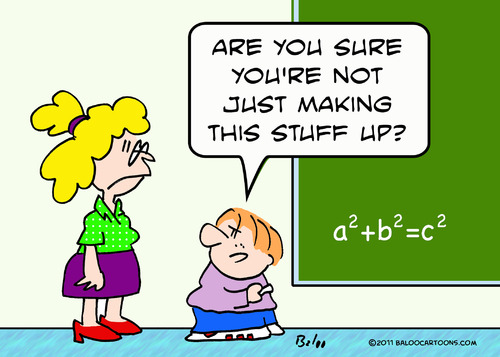
Thats how students feel
|
Geometry
Find the surface area of a cube that has a side length of 5 cm.
Me: I know the answer is 150 cm^2 because I know the properties of a cube. It has 6 sides with area 25 cm^2.
Student: I would have i explain to the student that the the sides of a cube are all the same. So the length, width, and height are all 5 cm. Also the students would need to know that there are 6 sides on a cube. No we add the area of each side of the cube to get the total surface area. We know each side is a rectangle so the area is width time height.
Side 1: 5cm*5cm = 25cm^2
Side 2: 5cm*5cm = 25cm^2
Side 3: 5cm*5cm = 25cm^2
Side 4: 5cm*5cm = 25cm^2
Side 5: 5cm*5cm = 25cm^2
Side 6: 5cm*5cm = 25cm^2
Total surface area = 150 cm^2
If the student can recognize the short cut and just do 25 * 6, then they should do it. If they don't feel comfortable then they should write out all the steps to the problem until they are comfortable with the shortcut.
As teachers we need to be able to effectively and clearly communicate with our students. They need to completely understand what we are teaching them. The best way to do that is by showing them all the details of a problem. Make them work it out step by step so their is no confusion. If there is till confusion then each step needs to be further explained or explained in a different way. If the students know how to do a problem step by step, they can eventually learn shortcuts and what steps they can remove from their process. Soon the concepts will be as easy to them as it is to us the teacher.