As I was leaving the class that I observe, the teacher informed me that she would not be in the classroom the following week. I asked her why. She said that she was going to the MACUL conference in Detroit. I decided to do some research on MACUL.
MACUL Conference
MACUL stands for Michigan Association for Computer Users in Learning. It is a non-profit organization that is dedicated to assisting the education community through support, promotion, and leadership in the effective use of educational technology. Their mission statement is "MACUL ignites learning through meaningful collaboration and innovation."
Many teachers go to the conference and a lot give presentations about how they have used a new technology in their classroom. These presentations allow teachers to share their ideas for other teachers to try and use. A conference like this encourages teachers to go find new ways to use technology in the classroom to benefit their students. They even allow student majoring in education to go as well. Next year they are coming to Grand Rapids and I think it would be something great to go to. I could learn a great deal from all these teachers.
Technology I have seen/used
I am currently observing in Mrs. Terrigno's Algebra and Geometry classes at Jenison High School. She use a lot of technology that can be quite helpful for students and her as well. One of the coolest resources she has used is infuselearning.com. Each student is given an iPad and goes to the site. They sign into her class so she can see their work. She puts a problem on the board, they work on the problem on the iPad, then they send the work to her. This allows Mrs. Terrigno to see how each student is doing. She told me that if just a few students get the question wrong, she will individually help them. If she notices that most of the class is getting the incorrect answer, she will go over the problem with the whole class. There is an example below.
A much more simple technological resource that Mrs. Terrigno uses is a desk projector. Sometimes she gives out story problems that involve more complicated pictures. These would be hard to draw on a whiteboard and could confuse students. Instead she can do the example on the paper and reference the picture. This allows the students to visually see how Mrs. Terrgino uses the picture to solve the problem. Another use for the desk projector is showing functions in the calculator. Calculators have many functions and some are hard to find or use. Using the projector to show the students what buttons to press is much easier than trying to explain how to use the function.
Two resources we have used in my Math 229 class are Desmos and Geogebra. They are both computer programs that allow you to visualize functions that you type in. In geogebra you can set up animations that show what happens when you change certain variables. You can set up games.
The example above is a football animation. You have to set all of the conditions and see if the quarterback can throw an accurate pass to his wide receiver.
In Desmos it is easier to create fun pictures like the batman symbol.
Pros of Technology
1. Technology can make things easier. Using the infuselearning.com allows a teacher to see which students are struggling easier. If the whole class understands, you can move on.
2. Programs like Desmos and Geogebra allows students to experiment. They set up animations and can experiment what happens when certain variables change. Students can start to pick up on patterns easier this way.
3. Visualizing is easier. In Desmos and Geogebra students can visualize what functions they are using. Again they can pick up on these patters to create fun pictures or animations.
Cons of Technology
1. Technology can distract students. Many times I saw students going on Facebook or other sites when using the iPads.
2. Students can improperly use technology. As you saw in the example of infuselearning.com, a student had drawn a face. Even though that's not what the student was supposed to draw, there is nothing the teacher can do from stopping something like that from happening.
3. Technology can be confusing. My first times using Desmos and Geogegra were very frustrating because I didn't know how to use the programs. I didn't really learn much at first because I was spending the whole time trying to figure out how the program works.
Overall
In the end I would say that technology is overall a good thing to have in the classroom. Teachers need to make sure that they are using technology effectively. To do this they must try maximize the pros of technology and minimize cons of technology. The technology should make the learning process fun and easier. If the technology is distracting and confusing, then there is no point in using it. An effective teacher knows how to use technology effectively.
Monday, March 23, 2015
Sunday, March 8, 2015
Baseball Statistics
There are many stats in the game of baseball. There are stats for fielders, pitchers, and hitters. Most of these are calculated by simply counting the number of times they happen. Examples of these stats are homeruns, stikeouts, RBIs, walks, hits, ect. There are some stats that require calculations. These are the stats I would like to discuss.
Hitters
Batting Average
Any baseball fan knows what a batting average is. It is the single most important stat for a hitter. A hitter with a low batting average is not a valuable asset to any team, regardless of his other stats. A players batting average is calculated by taking the number of times the player gets a hit and dividing by the total number of at bats for that player. Walks do not count as at bats in baseball. Lets say a player gets 4 at bats for in a game. In the game he gets 2 hits. So his batting average for that game is 2/4 or 0.500.
Above is Hall of Famer Ty Cobb. He is the all time leader in batting average for a career. He played for 24 years with the Tigers and the Athletics and had an impressive 0.366 batting average for his career.
On Base Percentage
On base percentage is similar to batting average. The only difference is that on base percentage takes into account errors and walks. If a player reaches base safely due to a walk, his on base percentage will go up but his batting average will remain the same. For example, lets say a player gets 10 at bats. He gets 6 hits, 2 walks, and 1 base by error. His batting average would be 6/8 or 0.750 while his on base percentage would be 9/10 or 0.900.
Slugging Percentage
Slugging percentage in a little more confusing than the previous 2 stats. Slugging percentage measures the power of a hitter. It takes into account whether the hitter gets singles, or something more than a single. Each hit does not count equally like it does in batting average. Slugging percentage is calculated:
1B, 2B, 3B, and HR stand for single, double, triple, and home run. Notice that the farther you get around the bases, higher your slugging percentage will be. Players who hit a lot of home runs often have high slugging percentages.
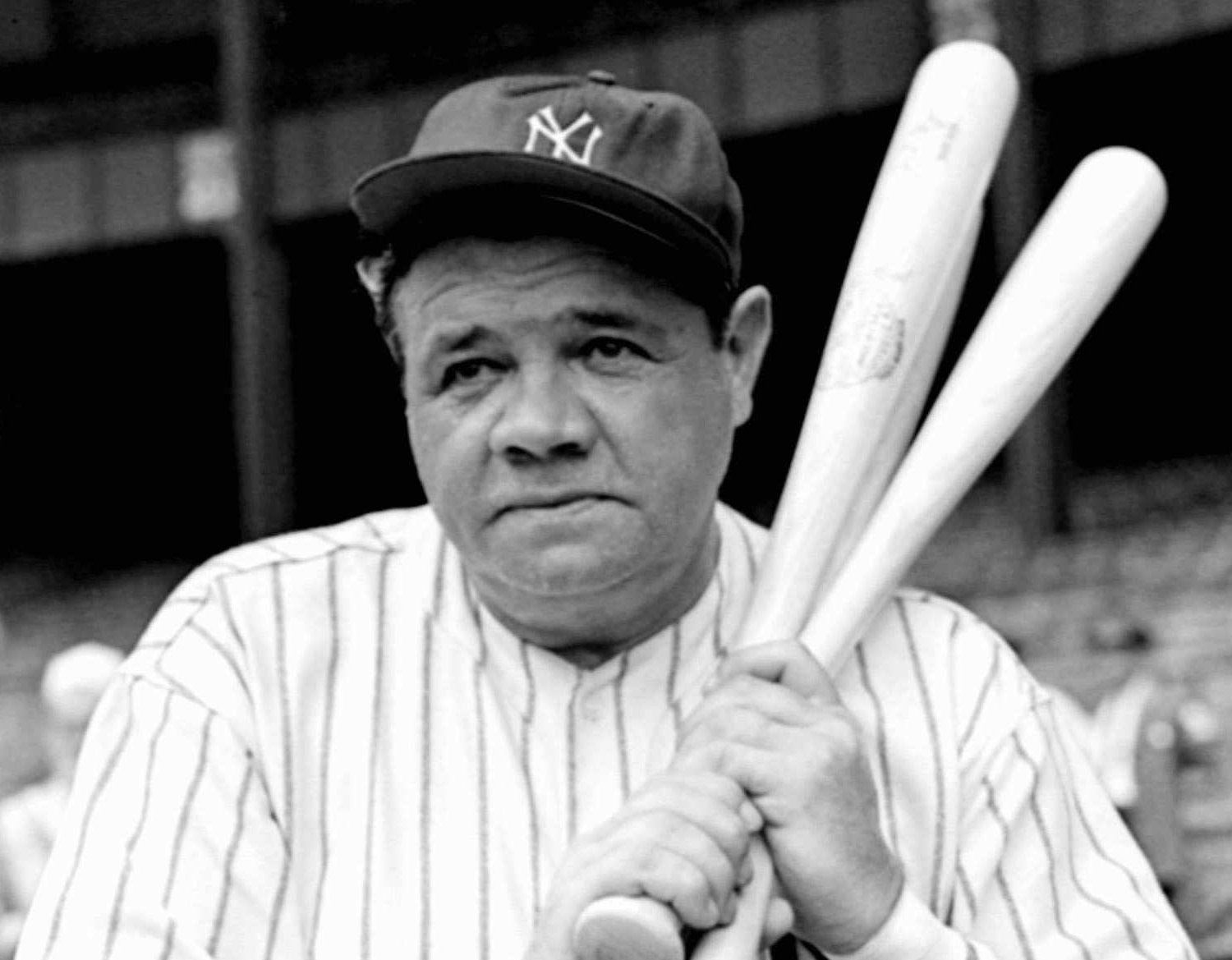
The guy to the left is Babe Ruth. One of the most iconic players in the history of baseball. n 1920, Babe Ruth played his first season for the New York Yankees. In 458 at bats, Ruth had 172 hits, comprising 73 singles, 36 doubles, 9 triples, and 54 home runs, which brings the total base count to (73 × 1) + (36 × 2) + (9 × 3) + (54 × 4) = 388. Divide that by 458 at bats and you get a 0.847 slugging percentage. That was quite impressive.
Then this guy to the right showed up and beat that record in 2001. Barry Bonds is also an iconic player, but for bad reasons. HE IS A CHEATER! HE TOOK STEROIDS AND WE ALL KNOW IT!! In 2001, Bonds racked 411 bases in 476 at bats which came to a 0.863 slugging percentage. That record still stands today
Pitching
Earned Run Average (ERA)
A pitcher's ERA is his most important stat. It is the average number of runs given up per nine innings by a pitcher. Starting pitchers who have the lowest ERAs are often up for the Cy Young Award which is given to the best pitcher in each league. ERA is calculated by taking the amount of earned runs, dividing it by the total number of innings pitched, and multiplying by 9. An earned run is only scored if there are no defensive errors. Let's say a batter hits the ball and it goes through a fielders hand. That is an error. If another player scores off of that error, a pitcher's ERA is not effected. If a pitcher pitches 30 innings and gives up 4 runs his ERA would be (4/30) * 9 = 1.19 which is pretty good.
Justin Verlander won the 2011 American League CY Young. He led the league with a 2.40 ERA. This stat, along with others, allowed him to be the first pitcher since 1986 to win the MVP award.
Walks plus Hits per Inning (WHIP)
A pitchers WHIP shows how efficient he is pitching. It shows how many base runners per inning a pitcher allows. Pitchers with lower WHIPs often pitch more innings since they do not give up as many base runners. WHIP is calculated by adding the amount of hits and walks a pitcher gives up and diving that by the number of innings pitched. If a pitcher pitches 50 innings and gives up 12 hits and 4 walks then his WHIP is (12+4)/50 = 0.320 which is not very good. Justin Verlander also had an impressive WHIP in 2011 which allowed him to win the Cy Young and MVP.
Many stats in sports are simply figured out by counting how many times they happen. In football there are many counting stats like touchdowns, yards, tackles, and interceptions. Hockey there are goals, assists and points. Those are major stats in their respective sports but they don't require any math, any calculation. Some of the most important stats in baseball require mathematical calculation.
Hitters
Batting Average
Any baseball fan knows what a batting average is. It is the single most important stat for a hitter. A hitter with a low batting average is not a valuable asset to any team, regardless of his other stats. A players batting average is calculated by taking the number of times the player gets a hit and dividing by the total number of at bats for that player. Walks do not count as at bats in baseball. Lets say a player gets 4 at bats for in a game. In the game he gets 2 hits. So his batting average for that game is 2/4 or 0.500.
Above is Hall of Famer Ty Cobb. He is the all time leader in batting average for a career. He played for 24 years with the Tigers and the Athletics and had an impressive 0.366 batting average for his career.
On Base Percentage
On base percentage is similar to batting average. The only difference is that on base percentage takes into account errors and walks. If a player reaches base safely due to a walk, his on base percentage will go up but his batting average will remain the same. For example, lets say a player gets 10 at bats. He gets 6 hits, 2 walks, and 1 base by error. His batting average would be 6/8 or 0.750 while his on base percentage would be 9/10 or 0.900.
Slugging Percentage
Slugging percentage in a little more confusing than the previous 2 stats. Slugging percentage measures the power of a hitter. It takes into account whether the hitter gets singles, or something more than a single. Each hit does not count equally like it does in batting average. Slugging percentage is calculated:
1B, 2B, 3B, and HR stand for single, double, triple, and home run. Notice that the farther you get around the bases, higher your slugging percentage will be. Players who hit a lot of home runs often have high slugging percentages.
The guy to the left is Babe Ruth. One of the most iconic players in the history of baseball. n 1920, Babe Ruth played his first season for the New York Yankees. In 458 at bats, Ruth had 172 hits, comprising 73 singles, 36 doubles, 9 triples, and 54 home runs, which brings the total base count to (73 × 1) + (36 × 2) + (9 × 3) + (54 × 4) = 388. Divide that by 458 at bats and you get a 0.847 slugging percentage. That was quite impressive.
Then this guy to the right showed up and beat that record in 2001. Barry Bonds is also an iconic player, but for bad reasons. HE IS A CHEATER! HE TOOK STEROIDS AND WE ALL KNOW IT!! In 2001, Bonds racked 411 bases in 476 at bats which came to a 0.863 slugging percentage. That record still stands today
Pitching
Earned Run Average (ERA)
A pitcher's ERA is his most important stat. It is the average number of runs given up per nine innings by a pitcher. Starting pitchers who have the lowest ERAs are often up for the Cy Young Award which is given to the best pitcher in each league. ERA is calculated by taking the amount of earned runs, dividing it by the total number of innings pitched, and multiplying by 9. An earned run is only scored if there are no defensive errors. Let's say a batter hits the ball and it goes through a fielders hand. That is an error. If another player scores off of that error, a pitcher's ERA is not effected. If a pitcher pitches 30 innings and gives up 4 runs his ERA would be (4/30) * 9 = 1.19 which is pretty good.
Justin Verlander won the 2011 American League CY Young. He led the league with a 2.40 ERA. This stat, along with others, allowed him to be the first pitcher since 1986 to win the MVP award.
Walks plus Hits per Inning (WHIP)
A pitchers WHIP shows how efficient he is pitching. It shows how many base runners per inning a pitcher allows. Pitchers with lower WHIPs often pitch more innings since they do not give up as many base runners. WHIP is calculated by adding the amount of hits and walks a pitcher gives up and diving that by the number of innings pitched. If a pitcher pitches 50 innings and gives up 12 hits and 4 walks then his WHIP is (12+4)/50 = 0.320 which is not very good. Justin Verlander also had an impressive WHIP in 2011 which allowed him to win the Cy Young and MVP.
Many stats in sports are simply figured out by counting how many times they happen. In football there are many counting stats like touchdowns, yards, tackles, and interceptions. Hockey there are goals, assists and points. Those are major stats in their respective sports but they don't require any math, any calculation. Some of the most important stats in baseball require mathematical calculation.
Subscribe to:
Posts (Atom)