Quarterback
The QB position is the most important position in the game of football. It is the hardest position to play because the precision that is needed to complete passes. When you think about throwing a football, it is just like projectile motion.

The equations for projectile motion are
Y=Yo + Vo*sin(a)*t+0.5gt^2
Y: vertical displacement of football
Yo: initial vertical displacement of football
Vo: initial velocity of football
a: angle at which the ball is thrown
g: acceleration due to gravity which is 9.8 m/s
t: time
X=Xo + Vo*cos(a)*t
X: horizontal displacement of the ball
Xo: initial horizontal displacement
All other values are the same as above
For the QB to throw the ball as far as possible, he must throw the ball at a 45 degree angle. That will be the perfect angle so the ball gets the most distance before it hits the ground. The average QB stands at 6'3''. The average QB can throw the ball about 60 yards. This means the average QB can throw the ball around 23 mph.
Receivers/Defensive Backs
For receivers and defensive backs, timing is everything. Receivers need to time their jumps, time their cuts in their routs, and time when they close their hands on the ball. Defensive backs also need to time their jumps and time when they try to swat the ball. The receiver also has to rely on the timing of the QB. The ball has to be thrown out in front of the receiver so that he can catch the ball in stride. If the receiver and the QB have good timing the below can happen:

The picture above is Randy Moss. In this picture he is "mossing" someone which is a term that he inspired. To "get mossed" means the receiver perfectly timed his jump so that he catches the ball when he reaches the highest point in his jump. Randy Moss made his career out of "mossing" defenders. When you think about it, you can mathematically calculate how to "moss" someone. The average receiver is around 6'3'' while the average DB is only about 5'11''. Both players have an average vertical jump of around 37 inches. If the receiver can time his jump so that he catches the ball while it is still 10+ feet from the ground (taking into account wingspan) he can successfully moss a defender. If not, the average DB will have a chance to knock the ball away for an incomplete pass.
Running Backs/Tacklers
The concept of tackling a running back with the ball is all about momentum. We know that the mathematical calculation for momentum is:
P=M*V
P: momentum
M: mass of the object
V: velocity of the object
There are only three possibilities that can occur when a tackler hits a runner. Those three are:
1. Tackler run overs runner
This will occur when the tackler has more momentum than the runner. This could be simply because the tackler is bigger or faster than the runner. He can generate more momentum and make the tackle.

2. Runner run over tackler
This will occur when the runner has more momentum than the tackler. This
could also simply be because the tackler is bigger or faster than the
runner. He can generate more momentum and will run the defender over. This does not mean he will break the tackle since the tackler can hold on. If a runner generates more momentum than a tackler, they will fall forward at least and gain a few more yards.
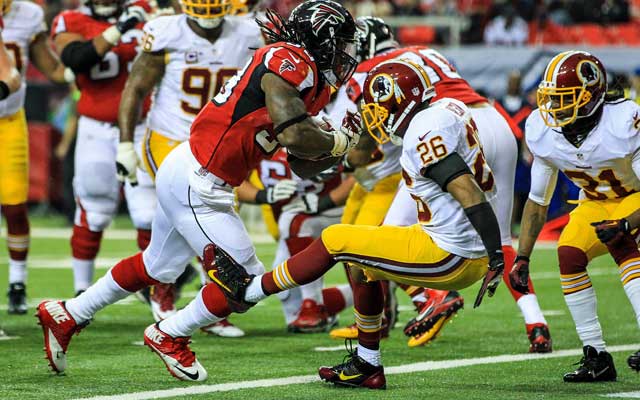
3. Neither player gets ran over
This will occur when both players have the same momentum. If both players have the same momentum then when they hit, they will not move. Often times this doesn't happen. Someone always gets pushed back. How is this possible if both players have the same momentum? Now is depends on where the players hit. There is a saying in football "low man wins". This refers to how low you hit someone. In reality it's how close you can get to someones center of gravity. The closer you are to that, the easier time you will have in moving an opponent backwards.
Football is a game for incredibly strong, fast, and athletic people. The game can be broken down into all kinds of physics and math that most people and players don't think about. A QB knows how hard, at what angle, and when to throw the ball. He doesn't often think about it, normally it's muscle memory. All other players do the same thing. They don't think about the specifics of the math and physics, but they use them their advantage to make plays and win games.

Very interesting ideas. I never thought to really take football skills and break them down to a formula standpoint. It's interesting to see that every aspect of a football game can be broken down into some form of mathematical ideas. Also like the idea that you could calculate "Mossing" someone!
ReplyDeleteSeems like the person to apply a little of this understanding to the game will have an edge in a competition where skills and talent are so close.
ReplyDeleteclear, coherent, complete, content, consolidated +
Caution: Footballs are so not smooth, air resistance is important. Makes 45 degrees not the best angle for the longest distance! And for shorter distances, minimizing time in the air is a big deal.