
High school math teachers take much higher math classes than the ones they teach. By the time they get back to teaching the lower level math classes, most of the material is simple and easy. They know short cuts and tricks that can make the work for the problem shorter. They don't have to write out the work completely to find the correct answer. Students usually need more explaining. They need the teacher to fully explain a problem for them to completely understand it.
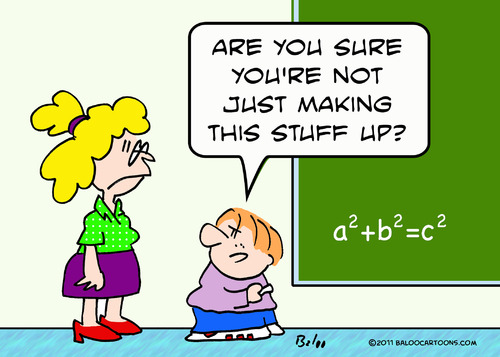
I have a few examples below that I can show from the class. I will show I could do it and how I would need to explain it to a student who has never seen the problem before
Algebra 1
Simplify the expression (x^2 * y^4 * z^5) *(y^2 * x^3 *z^1)
Me: Just by looking at it I know that the answer is (x^5 * y^6 * z^6)
All the work I do for the student I can do in my head.
Student: In this I would have to explain that you can only combine like terms. When you multiply like terms you add powers. So:
x^2 * x^3 = x^5
y^4 * y^2 = y^6
z^5 * z^1 = z^6
There for the final answer is x^5 * y^6 * z^6
 |
| Thats how students feel |
Find the surface area of a cube that has a side length of 5 cm.
Me: I know the answer is 150 cm^2 because I know the properties of a cube. It has 6 sides with area 25 cm^2.
Student: I would have i explain to the student that the the sides of a cube are all the same. So the length, width, and height are all 5 cm. Also the students would need to know that there are 6 sides on a cube. No we add the area of each side of the cube to get the total surface area. We know each side is a rectangle so the area is width time height.
Side 1: 5cm*5cm = 25cm^2
Side 2: 5cm*5cm = 25cm^2
Side 2: 5cm*5cm = 25cm^2
Side 3: 5cm*5cm = 25cm^2
Side 4: 5cm*5cm = 25cm^2
Side 5: 5cm*5cm = 25cm^2
Side 6: 5cm*5cm = 25cm^2
Total surface area = 150 cm^2
If the student can recognize the short cut and just do 25 * 6, then they should do it. If they don't feel comfortable then they should write out all the steps to the problem until they are comfortable with the shortcut.
As teachers we need to be able to effectively and clearly communicate with our students. They need to completely understand what we are teaching them. The best way to do that is by showing them all the details of a problem. Make them work it out step by step so their is no confusion. If there is till confusion then each step needs to be further explained or explained in a different way. If the students know how to do a problem step by step, they can eventually learn shortcuts and what steps they can remove from their process. Soon the concepts will be as easy to them as it is to us the teacher.

I like that you're thinking about the difference between how you do things for yourself and how you do things for students. I'm not convinced that students learn from detailed explanations, but authenticity is always good. But it's a weird kind of authentic, where you fill in some of the previous thinking that enables you to do your current thinking the way you do.
ReplyDeleteclear, coherent, complete, consolidated +
content - like to see you think about how your examples generalize. What characteristics should teacher talk have?
small point: x^2 and x^3 are not like terms (can add or subtract) but have the same base. And, obviously, it's all about the base.
I think that you did a great job explaining that students question the teachers 'bag of tricks.' The way you go about thinking about explanations is very important for your teacher as an educator. You must be able to provide examples and give a good explanation so that your students do not question you, but overall understand the topic your teaching. Good Job.
ReplyDeleteTo me your choice of topic was a very important one. Students are always struggling with understanding in their classes, especially math. As a student myself, I often find myself sitting at my table and staring blankly up at the board as my professor talks about what sounds like complete nonsense. An input of knowledge, with an output profit of, well nothing. For this exact reason it is important for teachers to teach in simplified to more complex ways, and even in multiple different approaches to assure an overall understanding. You explain this importance nicely, and I love you examples!
ReplyDeleteCan completely relate to this post. Too many times I forget when I'm tutoring for math that sometimes the easiest part of a question to me, could still be troublesome for the student. I feel like you hit the nail right on the head when you said "as teachers we need to be able to effectively and clearly communicate with our students." I think it's always important to remember that it's more important that students understand what we are doing, rather than try and get through all the material that needs to be covered.
ReplyDelete